
The history of food trucks, from Pompeii to Twitter
The history of food trucks in six dated stops: a Pompeii snack counter, a Texas chuck wagon, a night lunch wagon, the first taco truck, Kogi, Singapore.
3 min read
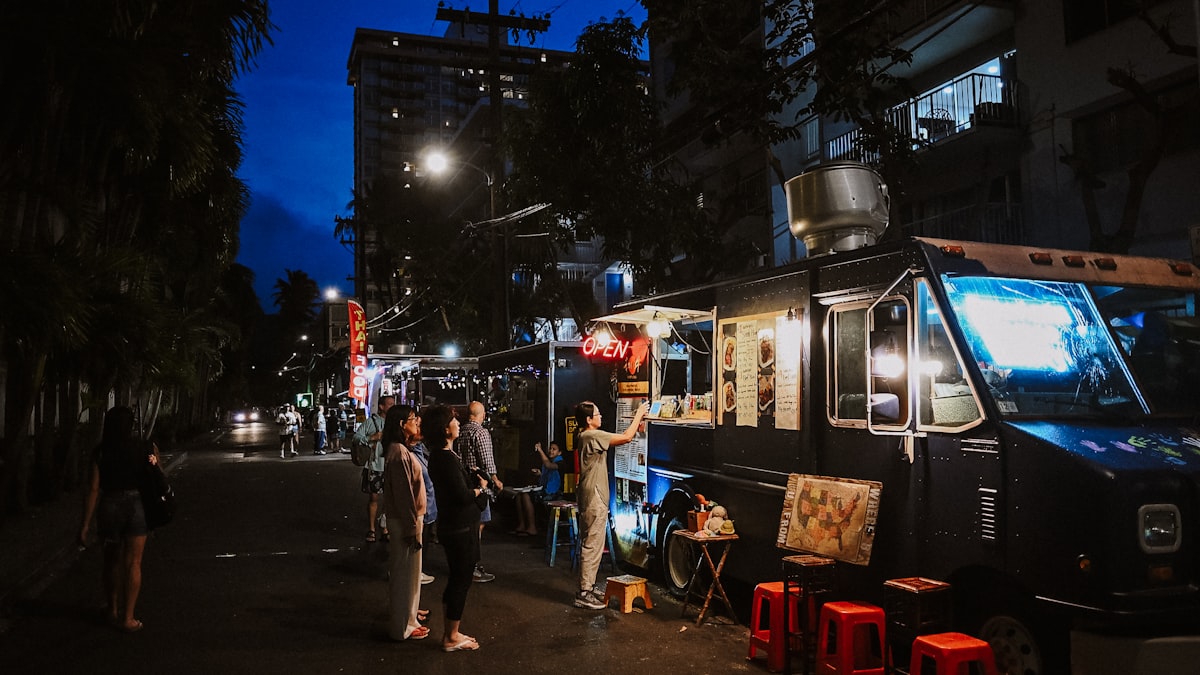
In the year 79, on a street corner in Pompeii, a snack counter was serving duck, goat, fish and snails from jars set into the stone when the volcano buried it.
Archaeologists dug the counter out in 2020, painted menu still on the front. So the history of food trucks starts long before the truck. The idea is the old one: food where the people are, no seats, pay and go.
Five stops after Pompeii
Texas, 1866. Charles Goodnight bought an army surplus wagon, bolted a box of shelves to the back and sent it up the trail with eighteen cowhands and a herd of cattle. The chuck wagon fed men who could not come to town. The kitchen came to them.
Providence, Rhode Island, 1872. Walter Scott gave up his newspaper job and parked a horse-drawn freight wagon at the corner of Westminster and Weybosset streets. He sold sandwiches and coffee to night-shift workers late at night, when the restaurants were closed. Many histories call it the first food truck in America. Others copied the wagon, later ones were parked for good, and that is where the American diner comes from.
East Los Angeles, 1974. Raul Martinez, a butcher from Mexico City, converted an old ice cream truck, named it La Güera and parked it next to a bar. He sold soft tacos, the kind he had grown up with. A year later he opened a kitchen to supply the truck. That is King Taco today.
Los Angeles, November 2008. At midnight outside a Hollywood nightclub, the Kogi truck sold Korean barbecue tacos and posted where it was on Twitter. That was the new part. Before Kogi, a truck waited for a crowd. After Kogi, the truck told the crowd where to come, and the crowd came.
Singapore, 16 December 2020. UNESCO put Singapore's hawker culture on its list of the world's intangible heritage. The city's street cooks work under one roof, in covered centres. By 2020 there were 114 centres and about 6,000 stalls, and the stalls were being added to Google Maps one by one so people could find them.
What it still teaches
The truck at the brewery on Friday, the cart outside the office at noon, the trailer at the festival. Same idea as the corner in Pompeii.
Every stop in the story solved one problem. Not "how do I cook", but "how do I get the food to the people".
Goodnight followed the herd. Scott parked where the night shift walked out. Martinez parked next to a bar. Kogi posted the address. Singapore put 6,000 stalls on a map.
The food changed every time. The job did not. If you run a truck, where you park is the first decision, and telling people where that is comes second. Customers check where you are before they decide to come, the same way a night-shift worker in 1872 looked for the wagon on the corner.
Today, open the link in your Instagram bio and check that it says where you are this week. Not last week.
Common questions
- Who invented the food truck?
- Nobody, and several people. Charles Goodnight built the chuck wagon in Texas in 1866 to feed cowhands on a cattle drive. Walter Scott parked a horse-drawn wagon selling sandwiches and coffee in Providence, Rhode Island, in 1872. Raul Martinez sold the first tacos from a converted ice cream truck in East Los Angeles in 1974. Each solved the same problem: bring the food to where the people are.
- When did food trucks become popular?
- The modern wave started in November 2008, when the Kogi truck in Los Angeles sold Korean barbecue tacos and posted its location on Twitter. People came to wherever the truck said it was. The idea, a truck plus a phone, spread from there.
Sources
- Archaeologists uncover well-preserved 'fast food' counter in Pompeii, France 24, reporting the Pompeii Archaeological Park announcement (2020)
- Goodnight, Charles, Handbook of Texas Online, Texas State Historical Association (2026)
- Walter Scott, Rhode Island Heritage Hall of Fame (2026)
- A Couple From Mexico Became Soft Taco Pioneers in Los Angeles 50 Years Ago, Smithsonian Magazine (2024)
- About Kogi, Kogi BBQ (2026)
- Hawker Culture is Singapore's first inscription on UNESCO's Representative List, National Environment Agency, Singapore (2020)
Nicolae Cojuhari · Software Engineer and Food Lover. Founder of 1FoodMenu.
Read next
Where to park a food truck: five spots, and where to start
Where to park a food truck: private lots with a crowd already on them, not the street. Five kinds of spots, the distance rules, and the two to start with.
· 4 min read
Food truck vs restaurant: what each costs to open
A food truck opens for about a quarter of what a restaurant costs. The ranges from three surveys, the permit bill nobody expects, and when each one wins.
· 3 min read

What customers check before choosing a restaurant
Customers open a restaurant's page for four things: the menu with prices, open or not, where it is, how to reach it. The numbers, and a ten-second check.
· 4 min read