Where to park a food truck: five spots, and where to start
Where to park a food truck: private lots with a crowd already on them, not the street. Five kinds of spots, the distance rules, and the two to start with.
4 min read
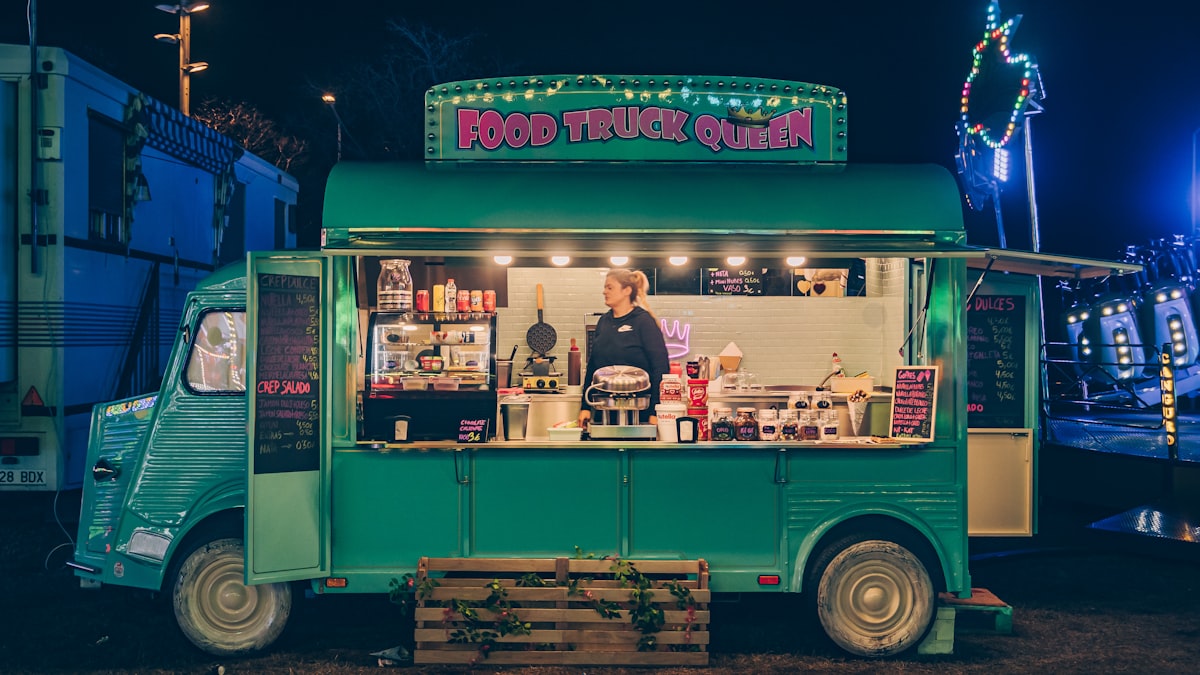
Where to park a food truck: on a private lot with a crowd already on it. The street is the hardest spot to get and the easiest one to be fined on.
Here are five kinds of spots, the rules that apply to all of them, and the two to start with.
Five kinds of spots
Office parks at lunch. Hundreds of people, one hour, few places to eat. You need a deal with the property manager, not the city, and the same spot every Tuesday builds a queue. Weekdays only, 11:30 to 1:30, and quiet in August.
Breweries and taprooms in the evening. Many small breweries have no kitchen and want people to stay for a second beer. So they want you there, often for free, and many post about it themselves. Friday and Saturday evenings, and the same trucks tend to get the same nights all season.
Events and festivals. The biggest days of the year and the most expensive to get into. Fees, a share of sales, or both, and you apply months ahead. One good festival pays for a slow week. One rained-out festival costs the fee anyway.
Other private lots with a crowd. Apartment complexes on a weeknight, hospitals on a night shift, gyms in the morning, hardware stores on a Saturday, churches after a service. Ask the owner and agree the hours in writing. These spots take one phone call, and most trucks never call.
The street. Public parking in a busy district. This is what people picture, and it is the hardest one. Metered time limits, distance rules, and other trucks that found the spot first. In Chicago you must stay 200 feet from any restaurant's main entrance. The fine is $1,000 to $2,000 per offence.
The rules that apply everywhere
Every US city writes its own rules. A 2018 study of 20 cities counted 45 separate procedures between buying a truck and opening the window.
45
Separate procedures a food truck goes through to open in a US city, taking 37 business days on average. (U.S. Chamber of Commerce Foundation, 20 cities, 2018)
Three rules come up in almost every city.
Distance. Minneapolis keeps trucks 100 feet from a restaurant, 300 feet from a home and 500 feet from a festival or stadium. Portland has no such rule outside the city centre.
Private property still needs a permit. The owner's permission is step one, not the whole thing. In Raleigh, the truck needs a vendor permit and the property owner files their own application for the lot.
A commissary. Many cities ask for a licensed kitchen where you prep, clean and park overnight. The signed agreement goes in with the permit application.
Portland, Denver and Orlando were the easiest of the 20 cities. Boston, Washington and San Francisco were the hardest.
Today, search your city's name with "mobile food vending" and read that page to the end. If you have not bought the truck yet, the permit bill belongs in the budget next to the truck itself.
Where to start
Two spots, not five.
One office park for weekday lunch and one brewery for Friday and Saturday nights. That is four or five services a week at the same places. Enough sales to see what works.
Write down the sales at each stop for a month. After four weeks you know which day and which spot pays, and you add a third spot, not a fifth.
Then tell people. Every truck in the history of food trucks solved the same two problems: where to park, and how to tell people. For a truck, "where are you" is the first thing a customer checks, and they check it before they decide to come. The spot is half the job. The other half is the week's schedule online, current, and one tap from your Instagram bio.
Common questions
- Can food trucks park anywhere?
- No. Every US city has its own rules, and most keep trucks a set distance from restaurants, homes, schools, hydrants and bus stops. Chicago keeps trucks 200 feet from a restaurant's main entrance and fines $1,000 to $2,000 per offence. Check your city's mobile food vending page before your first day.
- Can a food truck park on private property?
- Yes, with the owner's permission, and in most cities you still need a permit. In Raleigh, the vendor needs a food truck permit and the property owner files a separate application. Private lots are where most trucks make their money, because the crowd is already there.
- How far does a food truck have to be from a restaurant?
- It depends on the city. Chicago says 200 feet from the main entrance. Raleigh says 100 feet on the street. Portland has no such rule outside the city centre. The number is on your city's mobile food vending page.
Sources
- Food Truck Nation, U.S. Chamber of Commerce Foundation, 20 cities and 288 food truck owners (2018)
- Municipal Code of Chicago, 7-38-115 Operational requirements, City of Chicago (2026)
- Food Trucks on Private Property and the Public Right-of-Way, City of Raleigh (2026)
Nicolae Cojuhari · Software Engineer and Food Lover. Founder of 1FoodMenu.
Read next
Food truck vs restaurant: what each costs to open
A food truck opens for about a quarter of what a restaurant costs. The ranges from three surveys, the permit bill nobody expects, and when each one wins.
· 3 min read
The history of food trucks, from Pompeii to Twitter
The history of food trucks in six dated stops: a Pompeii snack counter, a Texas chuck wagon, a night lunch wagon, the first taco truck, Kogi, Singapore.
· 3 min read

What customers check before choosing a restaurant
Customers open a restaurant's page for four things: the menu with prices, open or not, where it is, how to reach it. The numbers, and a ten-second check.
· 4 min read