How to price menu items without guessing
Menu price = ingredient cost ÷ target food cost. Target ranges by restaurant type, one worked example, and the mistake that costs the most.
Updated 3 min read
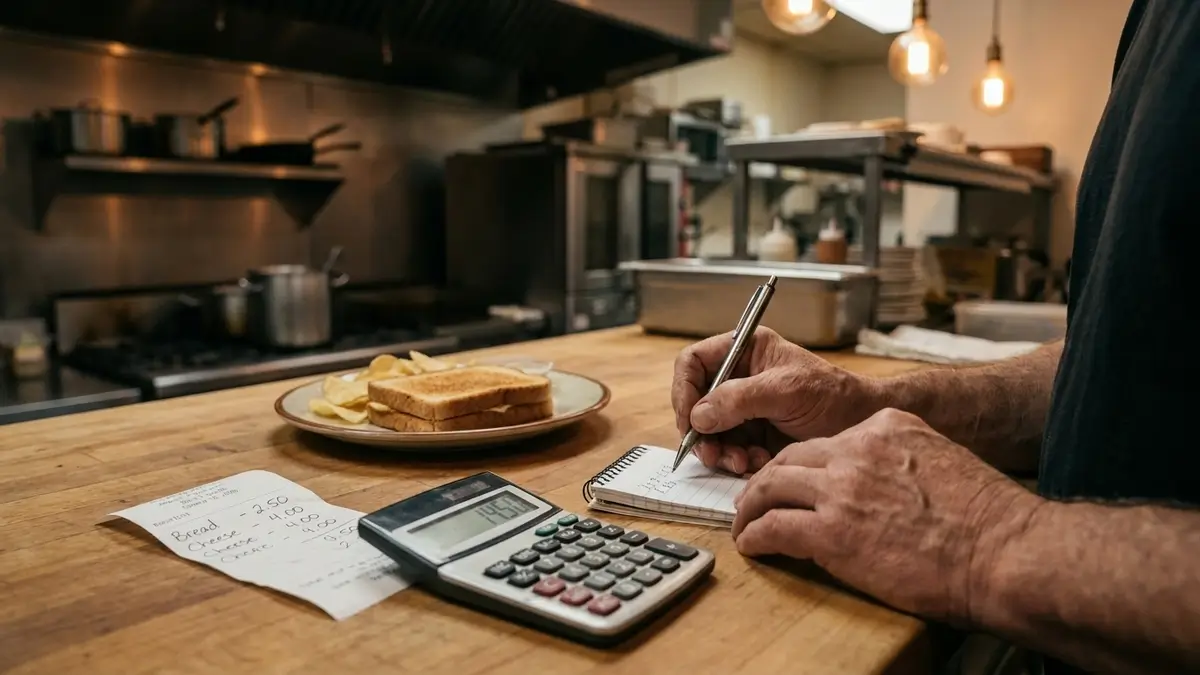
A menu price is one formula, not a guess. Ingredient cost, divided by your target food cost. Five minutes once you know what the dish actually costs.
What food cost means
Food cost is the ingredient cost of one dish, shown as a percentage of its price. A $4 dish sold for $16 has a 25% food cost. The average full-service restaurant runs 32.4% today (National Restaurant Association 2026 data, cited by WhippleWood, 2026).
That average hides a wide range. Most places aim for a target based on what they serve.
- Pizza and bar food
- 20–28%
- Quick-service
- 25–30%
- Casual dining
- 28–35%
- Fine dining
- 35–40%
Ranges, not a single number. Rent, labor and what's nearby all move where in the range you land. Source: GeniusFoodPurchasing (2026).
Price a dish in four steps
- Add up the real cost. Every ingredient in the dish, at what you paid for it, including the small stuff: sauce, garnish, the oil it's cooked in. Ten forgotten cents a plate is real money by the end of the month.
- Pick your target. Use the chart above as a starting point. A counter-service spot can run leaner than a sit-down dinner with table service.
- Divide cost by target. Price = ingredient cost ÷ target food cost. A burger that costs $3.60 to make, at a 30% target: $3.60 ÷ 0.30 = $12.
- Round it, then look at what's next to it. $12.00 or $11.99, whichever matches the rest of the menu. A $12 burger beside a $9 sandwich needs to look like more food, or one of the two prices is wrong.
One worked example
A chicken sandwich costs $4.20 to make: chicken, bun, sauce, pickle, the oil it takes to fry. The restaurant is casual dining, so the target is 30%.
$4.20 ÷ 0.30 = $14.00.
If a similar sandwich down the street sells for $11, that's worth knowing, but it doesn't make $14 wrong. It means the menu should say why: "hand-breaded, brined overnight." Or it means checking the ingredient cost again, in case something crept up.
The one mistake
Pricing every dish to the same percentage. A $4 side and a $28 steak should not both target 30%. High-cost dishes can usually carry a lower percentage, since their dollar profit is already large; low-cost sides and drinks can carry a higher one. Price the whole menu to land on the average, not each dish to hit one number.
Common questions
- What is a good food cost percentage for a restaurant?
- It depends on the kind of place. Quick-service usually runs 25% to 30%, casual dining 28% to 35%, fine dining 35% to 40%, pizza and bar food 20% to 28% (GeniusFoodPurchasing, 2026). The average full-service restaurant runs 32.4% today, per the National Restaurant Association's 2026 data, cited by WhippleWood.
- How do you calculate the price of a menu item?
- Divide the dish's ingredient cost by your target food cost. A dish that costs $3.60 to make, priced at a 30% target, comes to $3.60 ÷ 0.30 = $12. Round it to match the rest of your menu, then check it against what's next to it.
Sources
- What Should Food Cost Be in a Restaurant?, GeniusFoodPurchasing (2026)
- Restaurant Financial Benchmarks, WhippleWood, citing the National Restaurant Association's 2026 State of the Industry report (2026)
Nicolae Cojuhari · Software Engineer and Food Lover. Founder of 1FoodMenu.
Read next
How to write a restaurant menu that is easy to order from
Fewer dishes, the order people actually read in, names that say what the dish is, and prices without a dollar sign. What the menu studies found.
· 4 min read
Should restaurant menus include photos? Yes, with one rule.
Photos next to plain dish names raise what people pay and order, three studies found. The one rule, and how to take menu photos with a phone.
· 4 min read
How to fill slow days at a restaurant: five things that work
How to fill slow days at a restaurant: a weekday special with a name, a fixed-price lunch, a partner's quiet night, a stamp card, and hours that are true.
· 4 min read